
Anthony Caro (1924 - 2013)
“Anthony Caro was one of the outstanding sculptors of the past fifty years alongside David Smith, Eduardo Chillida, Donald Judd and Richard Serra. In the sixties, he established a new language for sculpture in a series of elegant, arresting, abstract steel sculptures placed directly on the ground. His development of this vocabulary, building on the legacy of Picasso, but introducing brilliant colour and a refined use of shape and line, was enormously influential in Europe and America. Caro admired the sculpture of ancient cultures and Greece and from the eighties onwards produced a series of large scale abstract works that reflected a continuing interest in the human body, but also a growing fascination with architecture. Caro was a man of great humility and humanity whose abundant creativity, even as he approached the age of ninety, was still evident in the most recent work shown in exhibitions in Venice and London earlier this year.”
— Nicholas Serota, Director, Tate (October 2013)
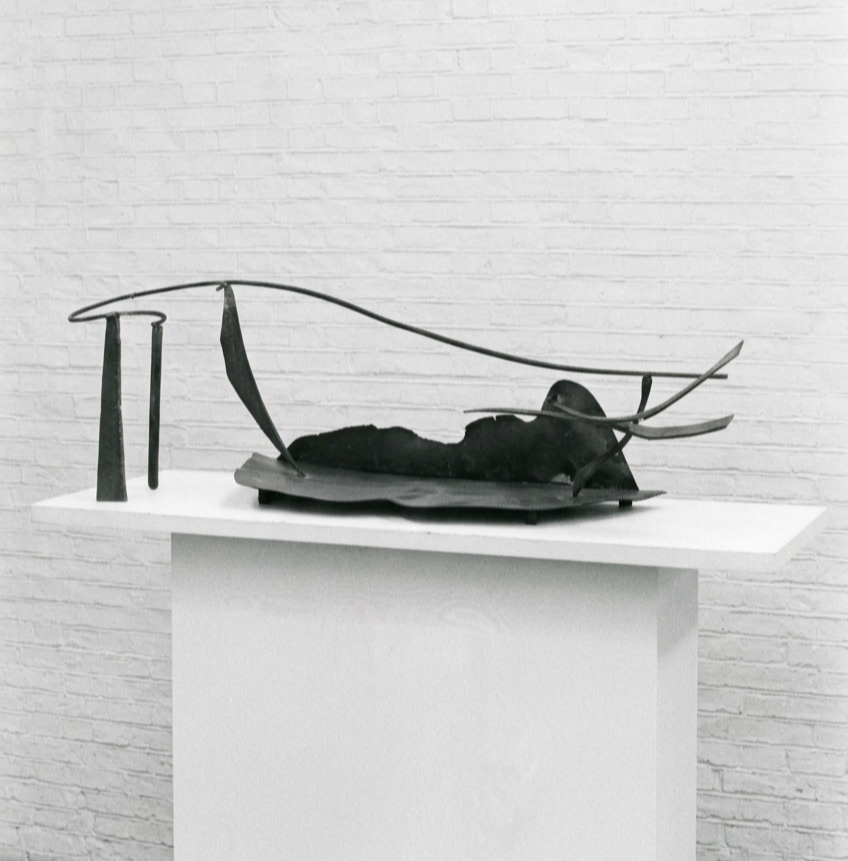
Anthony Caro, Table Piece CCII, 1974 Steel, varnished, 24 × 71 × 23 inches
Anthony Caro was a British sculptor born in New Malden, Surrey, in 1924; he died in London in 2013. He played a pivotal role in the development of twentieth-century sculpture, helping redefine the relationship between sculpture, space, and viewer. He studied sculpture at the Royal Academy Schools in London and worked as an assistant to Henry Moore from 1951 to 1953. Caro came to public attention with his 1963 exhibition at the Whitechapel Gallery, where he presented brightly painted abstract steel sculptures placed directly on the ground, a radical departure from traditional pedestal-based sculpture.
Although best known for his work in steel, Caro also worked with bronze, silver, lead, stoneware, wood, paper, and other materials. He taught at St Martin’s School of Art in London from 1953 to 1981, where his questioning approach helped open new possibilities for sculpture. Major exhibitions include retrospectives at the Museum of Modern Art, New York; Museum of Contemporary Art, Tokyo; and Tate Britain, London. He was knighted in 1987 and received the Order of Merit in 2000.